
Luxury Ecotourism Digital Marketing Trends: 2026 Edition
What has changed, what still works, and where to invest next.

By Barend Potgieter, Backbone. He advises luxury tourism brands on digital strategy, conversion and demand generation.
LinkedIn
Published July 2026 · Last updated 20 October 2026
01 · Foreword: Five Years Is a Lifetime in Digital
We first researched digital marketing for luxury tourism in 2021.
The conclusion from that report was four big bets:
- Luxury had shifted from owning to experiencing.
- Storytelling was everything.
- Engaged customers were a destination’s most valuable asset; and
- Loyalty, personalisation and community would decide who wins the affluent traveller.
Five years later, every one of those bets has paid off.
But the playbook for how to seize the opportunity was in need of an evolution.
Increasingly travellers no longer start their journey with a Google search. Short-form video has restructured the content economy. A guest’s shaky phone footage now outperforms your polished brand film. And a new gatekeeper has arrived between you and your future guest: the AI assistant.
The single biggest shift in five years:
Your next guest may never see your website before an AI has already decided whether to recommend you. Roughly 80% of travellers now use AI tools in travel planning, yet only about 16% of global hotel supply is visible in AI search results on ChatGPT, Google AI and Perplexity.
Contents
Part One · The Landscape
- 02 · The Market
- 03 · The Psychology of the Modern Luxury Traveller
- 04 · Regenerative Travel: Purpose Became the Product
Part Two · The Compounding Guest
Part Three · Be Found
- 06 · The AI Discovery Shift (AEO & GEO)
- 07 · Content: Review Marketing, Now Also AI Fuel
- 08 · Paid Media: Renting Reach in the AI Era
Part Four · Be Chosen
- 09 · Content Quality: The Authenticity Premium
- 10 · Content: Video, Short-Form Economics
- 11 · Content: UGC, Your Guests Are the Production Department
- 12 · Content: Micro-Influencers, The Creator Economy Grew Up
Part Five · Belong
- 13 · Community & Owned Audiences: The Moat
- 14 · Personalisation, From CRM Hygiene to AI enabled Hyper-Personalisation
- 15 · Loyalty Programs, From Points to Data Engines
- 16 · The Rise of Analog
The Playbook
PART ONE
The New Landscape
Who is buying luxury travel in 2026, what do they want, and where is demand moving?
02 · The Market
Before we dive into the psychology of the buyer, we examine the size of the prize. Three things stand out in the data: the market is compounding fast, the top end is carrying it, and the next decade could belong to Africa.
A market on a steep trajectory
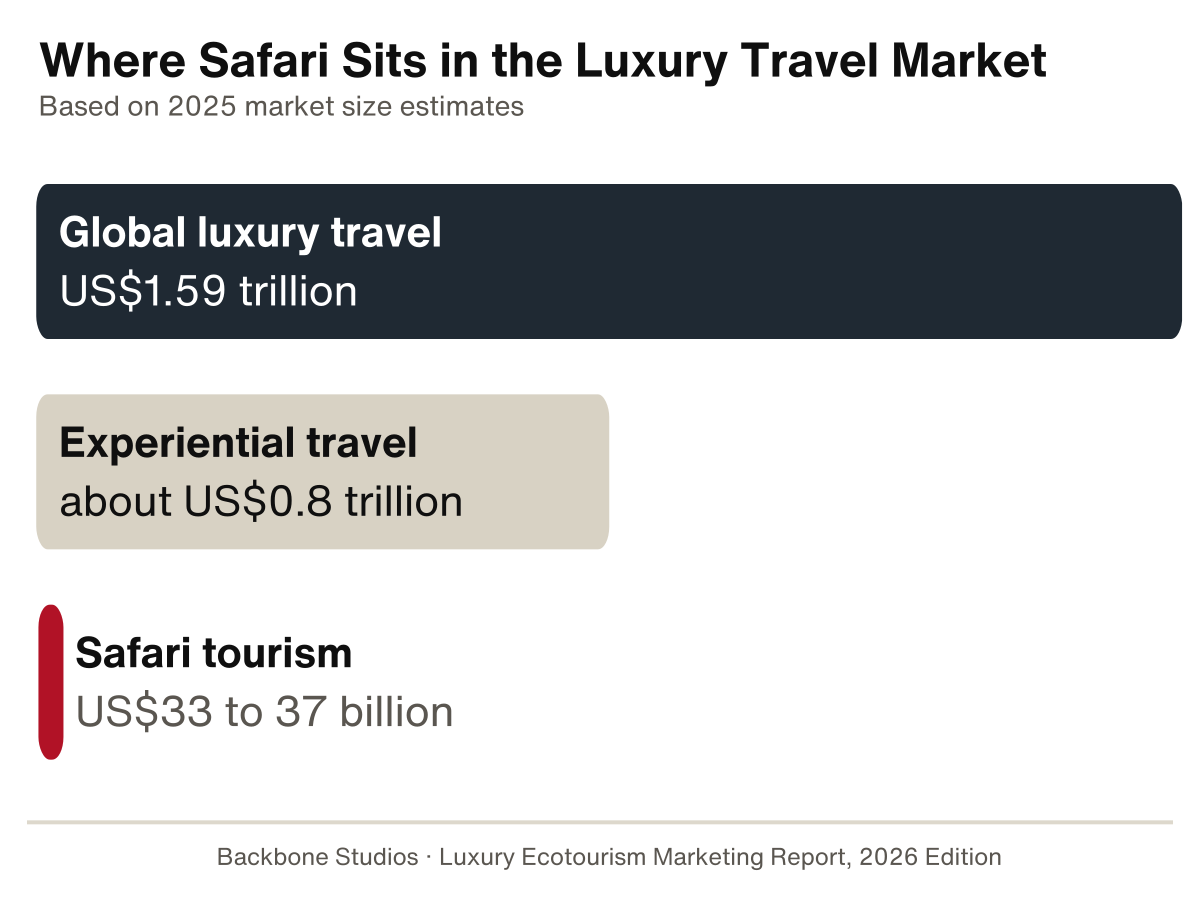
The global luxury travel market is valued at approximately US$1.59 trillion (2025) and is projected to reach US$3.04 trillion by 2033, a CAGR of about 8.5%. (Grand View Research)
Experiential travel is estimated to account for around half of the luxury travel market.
Safari tourism is estimated at US$33-37 billion (2024/25) and projected to reach about US$61 billion by 2030 (IMARC Group), with the luxury safari segment growing faster (CAGR 7.6–8.2%) than the broader market. (Verified Market Research)
Demand-side drivers reported for luxury safari: a 46% rise in demand for eco-luxury experiences, 39% preference for private lodges, and 32% growth in digital-detox travel. (Global Growth Insights)
The opportunity is real (and massive), but also a word of caution: The premium tier is carrying the whole industry. Moody’s Analytics found the top 10% of US earners now account for nearly half of all consumer spending; about half of travellers with $1 million or more in assets increased their travel budgets in 2025, and over a quarter plan to spend $50,000 or more on travel. The global luxury hotel market is projected to grow from $154 billion (2024) to $369 billion by 2032, and the number of hotels charging over $1,000 a night tripled in the Americas and Europe between 2019 and 2024. (Skift Megatrends 2026)
You want to capture market share and ride this wave, but be wary that if tides change you are not left over-exposed.
The demographics have flipped
Millennials and Gen Z are expected to account for 60-70% of all luxury purchases by 2030 (PressReader), and 88% of them plan to maintain or increase travel budgets in 2026 (WiT / Klook). Meanwhile the luxury market has democratised: McKinsey estimates 35% of luxury travellers have a net worth between $100,000 and $1 million, and 80% of the luxury leisure market is under 60.
Your buyer is younger, more digital, more values-driven, and researching you in places you may not be watching.
Africa: the next frontier.
Africa is entering a defining phase. The World Travel and Tourism Council estimates the continent’s travel sector could add more than $350 billion to its economy over the next decade, and Skift Research finds nearly eight in ten travellers in Saudi Arabia and the UAE plan a luxury trip in the next twelve months, opening a powerful Middle East to Africa corridor.
The demand wave is coming, and the brands and operators that are visible and bookable when it arrives will take a disproportionate share. The time to act and position yourself to catch this wave is now
(Skift Megatrends 2026).
03 · The Psychology of the Modern Luxury Traveller
The long migration from having to being, from owning to experiencing, is complete. Luxury in 2026 is defined by intention, access, wellbeing and emotional resonance, not thread counts and champagne service. Analysts describe the dominant aesthetic as “quiet luxury”: understated, private, restorative environments over flashy resorts.
Beneath the numbers sits a psychological shift our 2021 research caught early. Back then, drawing on a Finnish study of luxury tourism, we defined the core of the luxury experience as pleasure and meaning: hedonic and eudaimonic wellbeing experiences that make the guest feel special. Five years on, that definition has aged remarkably well. Only the weighting has moved.
The hedonic side, comfort, indulgence, beauty, sensory harmony, is now table stakes. Every operator at this level can deliver a beautiful room and an exceptional meal. The eudaimonic side is where the premium now sits: growth, connection, purpose, and the sense of coming home slightly changed. That is why wellness, learning and conservation participation keep outperforming pure indulgence in the demand data.
Three psychological drivers worth designing for:
- Identity over display. The 2021 traveller bought what luxury looked like; the 2026 traveller buys what it says about them. Quiet luxury is a status language for insiders: understatement signals confidence, and the story of the trip has replaced the logo as the flex.
- Scarcity of feeling, not of things. What is genuinely rare in an affluent life is silence, privacy, unstructured time and awe. The 2021 study called it purity, tranquility and freedom; today it surfaces as digital-detox demand and the flight to remoteness.
- The human bond. The 2021 research listed presence, empathy, intimacy and natural storytelling as core components of the experience. Nothing in five years has dislodged this.
What does the Luxury Traveller want in 2026 and beyond?
Wellness has moved from amenity to primary motivator. In many cases it is not an add-on to the itinerary; increasingly it is the itinerary.
Booking.com reports 80% of travellers are open to booking skin and beauty treatments during a trip in 2026, rising to 93% in India, and 38% of Gen Z travellers plan to seek out treatments while travelling, double the rate of boomers. (Skift Megatrends 2026)
Slow travel, longer stays, fewer stops, deeper immersion, is replacing the packed itinerary.
Nearly 70% of European travellers are open to replacing short-haul flights with rail where viable, and luxury sleeper train products are launching at $10,000 to $18,500 per journey. Notably, only 15 to 17% cite the environment as the main reason; most simply prefer the slower, more comfortable journey (Skift Megatrends 2026). Privacy and exclusivity (private villas, membership clubs, closed-group experiences) continue to command premiums.
And the guide, tracker and host remain the single most memorable element of the trip; everything in the data suggests their marketing value is still underexploited. There is so much more to unpack when it comes to the hosting element, but we’ll leave it for a future report.
04 · Regenerative Travel: Purpose Became the Product
Regenerative tourism, leaving the destination measurably better, is widely identified as the defining luxury trend of the year (Forbes). Purpose is no longer a nice-to-have narrative, but the product itself.
- Demand for regenerative experiences is reported up about 40% versus 2023 (Earth Changers).
- Investment in eco-lodge development has grown about 89% since 2019, with focus on properties that produce more energy than they consume (Mindful Ecotourism).
- African safari ecolodges command among the highest rates in the industry. Luxury sustainable lodges average $1,500-3,000 per night, often booked 12-18 months in advance.
- “Conservation adventures” are a fast-growing premium product. Here guests participate in wildlife monitoring, collaring or marine research, often run with research institutions.
The marketing implication is undeniable: conservation is no longer something that lives on the CSR page.
It has become:
- The storytelling spine,
- The loyalty programme’s Vision layer,
- The exclusive content (research feeds, ranger diaries, impact dashboards), and
- The justification for premium pricing.
Measurement matters: Vague green claims read as greenwashing and specific, dated, audited impact numbers convert.
In late 2025 the EU moved against 21 major airlines over misleading environmental claims, and “carbon neutral flight” options are disappearing from booking pages across the industry. The green-marketing collapse raises the bar for everyone in travel: unverifiable claims are becoming a compliance AND a credibility risk.
Properties with specific, audited impact numbers will inherit the trust the industry’s vague claims squandered. (Skift Megatrends 2026)
One way to take advantage of this?
Impact dashboards as content. A live, public page of hectares restored, animals collared, community jobs created. Your quarterly updates automatically become newsletter, social and PR content.
Questions we get asked
Is luxury travel still growing, or am I looking at a bubble?
Both are worth holding in mind. The market is projected to grow from about US$1.59 trillion in 2025 to US$3.04 trillion by 2033, a compound rate of roughly 8.5% (Grand View Research). But the premium tier is carrying the industry: the top 10% of US earners now account for nearly half of consumer spending. Ride the wave, and avoid over-exposure to a single high-end segment.
Who will my luxury guests be over the next decade?
Younger and more digital than most lodges plan for. Millennials and Gen Z are expected to account for 60 to 70% of luxury purchases by 2030, and McKinsey finds 35% of luxury travellers now have a net worth between US$100,000 and US$1 million. They are values-driven, research you in AI assistants and on social platforms, and prize wellness, privacy and meaning over thread counts.
Do regenerative credentials actually justify higher rates?
Yes, when they are specific. Luxury sustainable lodges average US$1,500 to 3,000 a night and are often booked 12 to 18 months in advance, while demand for regenerative experiences is reported up about 40% versus 2023. The caveat: vague green claims now read as greenwashing and carry regulatory risk. Publish dated, audited impact numbers and build your premium on them.
PART TWO
The Compounding Guest
Your most important growth engine, bar none, is the engaged guest. Win and wow one properly, and they pay you back across every marketing initiative. The engaged guest is your highest return asset.
05 · The Value of the Engaged Customer: Compounding Interest
A highly engaged customer has always been the ultimate end goal, but their value has now compounded far beyond repeat purchase and LTV.
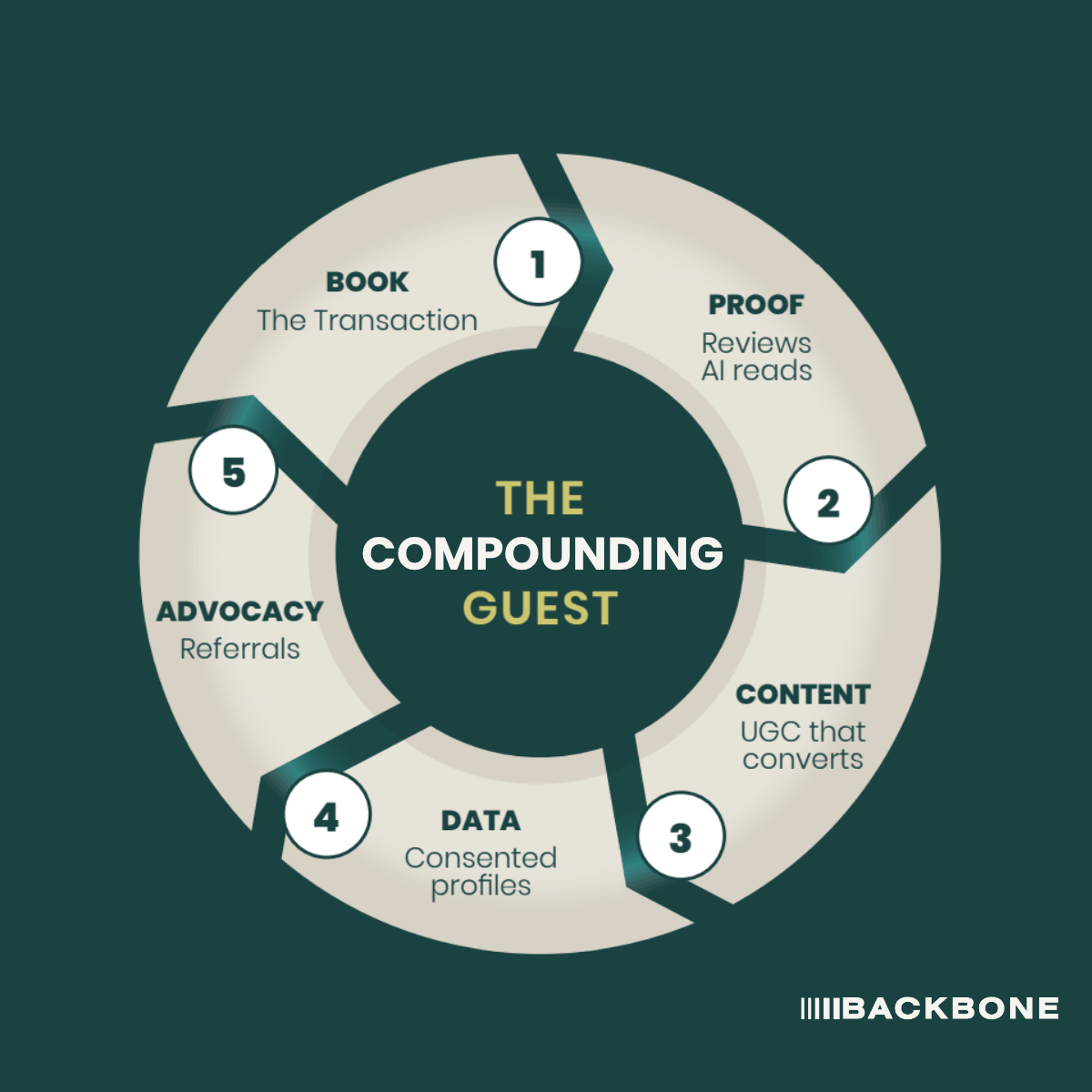
In 2026, the value of the engaged customer is seen through their roles as:
- AI visibility Signal: Their reviews shape the sentiment signals AI assistants use to decide whether to recommend you.
- Content Studio: Their photos and videos (UGC) that outperform your brand content in paid and organic social.
- Data Asset: Their first-party data – the only durable targeting asset left in a privacy-constrained ad market – that fuels your targeting pools and business intelligence.
- Advocate: Their referrals -on and offline, that promotes you to their close circle.
The output from each of these roles compound across each touch point, helping you to be found, be chosen and nurture a community where they and others can belong – creating value far beyond their initial purchase.
We call this the Compounding Guest, and it’s a model we use to help our clients overcome the obstacles to their growth.
Questions we get asked
What makes an engaged guest worth more than a repeat booking?
A repeat booking is one transaction; an engaged guest works for you between stays. They refer their circle, their photos and videos outperform your brand content in paid and organic social, their reviews shape the sentiment signals AI assistants weigh, and their first-party data powers your targeting and intelligence. Each role compounds the others, which is why this model treats the engaged guest as the engine, not the outcome.
How do I measure engagement beyond revenue?
Track the four outputs. Referrals: bookings traced to guest recommendations. Content: usable guest photos and videos banked per month. Data: profiles with consented preferences in your CRM. AI visibility: how often you appear when ChatGPT, Gemini and Perplexity are asked twenty realistic guest questions. Cost per engaged guest tells you more about next year’s revenue than cost per click ever will.
Where should a small lodge start with this model?
Start with the guests you already have. Survey past guests on preferences, community appetite and channels; it remains the highest-leverage first move in this report. Consolidate every guest record into one CRM with explicit consent, then open one owned channel, a WhatsApp community or an editorial newsletter. Every later stage of the model depends on this foundation catching the value your marketing creates.
PART THREE
Be Found
Discovery has a new gatekeeper. This part covers how travellers find you now: the AI answer, the reviews that feed it, and where paid reach still earns its keep.
06 · The AI Discovery Shift

This is the biggest shift in travel marketing today, and the one few are prepared for.
Remember how ‘Google’ became a verb? Well, that’s quickly being replaced by whatever we’ll end up calling the act of chatting with your favourite AI.
Generative AI platforms such as ChatGPT, Gemini, Perplexity, and Claude have become a genuine travel-planning channel. An Accenture survey of 18,000 consumers across 14 countries found 80% of travellers use AI tools for travel purposes, and over half are willing to let AI fully manage planning and booking (Hospitality Investor). Travellers increasingly don’t search and browse; they ask and get.
Recent traffic data studies have confirmed the shift:
- Conversational AI firm Satisfi Labs reports organic search traffic across its 800 tourism clients ranging from flat to 30 or 40% down.
- Adobe Analytics measured US travel site visits from AI sources up 3,500% year on year by mid 2025, with 29% of consumers using AI for trip planning.
- And the economics of being scraped have inverted: Cloudflare’s CEO notes that where Google once sent one visitor for every two pages it crawled, OpenAI’s ratio is roughly 250 pages per visitor, and Anthropic’s runs into the thousands. The machines are reading everything and sending almost no one.
Our own work across clients shows the same trend – a steady increase in referral traffic from LLMs, month over month. If this trend continues, visibility inside the answer is the only traffic that survives. (Skift Megatrends 2026)
Only about 16% of global hotel supply is visible in AI search results.
For small luxury tourism properties this is an asymmetric opportunity: the field is nearly empty, and the traveller asking an AI for “a regenerative safari lodge in the Waterberg with private guiding” is the highest-intent prospect imaginable. (PhocusWire)
The new SEO disciplines: AEO and GEO
Answer Engine Optimisation (AEO) targets the single direct answer, the AI Overview, the voice answer, the ChatGPT recommendation. Generative Engine Optimisation (GEO) targets the factors AI systems use to judge credibility: editorial coverage quality, review sentiment, structured content depth, and consistency of brand information across the web.
Some tips on how to rise to the top:
- Be fully indexable on both Google and Bing (Bing feeds ChatGPT).
- Mark up pages with LodgingBusiness, FAQPage and Speakable schema.
- Own your AI answer. Publish self-contained 60-90 word answers to the questions travellers actually ask, backed by specific, dated facts (rates, seasons, species, distances, accessibility).
- Cultivate third-party editorial mentions and healthy review sentiment. AI assistants weigh what others say about you more than what you say about yourself.
- The podcast as GEO. A luxury-travel podcast featuring your destinations and guests doubles as AI-visibility work: transcripts and editorial coverage are the types of third-party signals AI systems look for.
- Audit yourself quarterly: ask ChatGPT, Gemini and Perplexity the queries your guests would ask, and track whether (and how) you appear.
- Get good PR. PR is now good GEO – Ahrefs research shows brand visibility in AI summaries correlates strongly with mentions across the web rather than backlinks. (Skift Megatrends 2026)
- Agentic booking readiness. Over half of travellers say they’d let AI manage bookings. If AI can’t read your rates, availability and booking policies, it can’t book you. Make this information machine-readable or risk disappearing from AI-assisted booking journeys.
07 · Content: Review Marketing, Now Also AI Fuel
Why are reviews so important?
- 95% of leisure travellers read reviews before booking, and 93% say reviews influence their decision (Hotelagio).
- Three-quarters of travellers will pay more for lodging with better reviews; among travellers under 40 it rises to 80% (Expedia Traveler Value Index).
- Tripadvisor hosts 2 billion+ reviews (WiserReview) and has deployed AI review summaries and an AI trip-planning assistant (Tripadvisor), meaning a handful of themes in your reviews get amplified into the one-paragraph verdict most travellers read.
- And now reviews carry a new job – Reviews are a primary sentiment signal AI assistants use when deciding whom to recommend.

That’s why Review Marketing is a key activity for and tourism business, and should be a central part of your strategy. The foundation plan for Review Marketing remains evergreen:
- Audit your reputation regularly,
- Collect emails,
- Request reviews post-stay,
- Respond to everything,
- Follow up.
Add two steps for the AI era:
- Monitor what AI summaries say about you on Tripadvisor and Google, and
- Deliberately seed review language. Guests echo the phrases you use at checkout and in follow-up emails, and those phrases surface in AI summaries.
08 · Paid Media: Renting Reach in the AI Era
So far we’ve covered earning your place in the answer. Paid media buys you a seat while you do.
Rented reach keeps getting more expensive, so every cent spent on paid media has three legitimate jobs:
- Bridge the gap while your organic and AI visibility matures,
- Amplify the guest content that already outperforms your brand creative, and
- Re-reach the audiences you own.
Ads inside the answer
The AI platforms have started selling visibility inside their answers:
- OpenAI began piloting ads in ChatGPT in early 2026 and reached a reported US$100 million annualised run rate within months, at premium CPMs around US$60 (Digital Applied).
- Google now shows ads alongside roughly a quarter of AI Overviews, up from about 5% in early 2025 (Digital Applied).
For a luxury tourism provider the play is a small, early test budget. The traveller asking an AI for a private safari lodge with regenerative credentials is the highest-intent prospect in the funnel, and the auction for that attention is not yet crowded. Watch measurement closely, learn and only scale based on results.
The channel map for luxury tourism
Each of the big paid channels now has one distinct job:
- Reddit, the trust play. Ad revenue grew 74% to US$2.1 billion in 2025 (AffMaven), and 82% of users trust recommendations from fellow Redditors, more than on any other platform (Shno). High-intent travel research lives in the subreddits. Reddit threads feed AI answers so presence there doubles as GEO.
- Pinterest, the planning play. 631 million monthly users, with around 70 million engaging travel content every month, and Pinners are twice as likely to have spent over US$5,000 on upscale travel in the past year (Mary Lumley). Planning starts months ahead, average CPCs sit well below Meta (Digital Applied), and content has a long half-life: a bucket list vacation board pin works for years.
- TikTok, the amplification play. Spark Ads, which promote real creator posts rather than brand accounts, deliver roughly 30 to 40% lower CPA and far higher completion rates than standard in-feed ads (inBeat), and two-thirds of Gen Z now search TikTok for travel and reviews (Digital Applied). This is where the UGC and creator sections become media spend: put your money behind the guest content that already works.
- Instagram, the shortlist play. Still the default visual proof point for luxury travel, and the creative rule has inverted here too: UGC-style Reels with native fonts and lo-fi production are now the highest-converting prospecting format, at the lowest cost per impression of the major platforms (2026 creative benchmarks).
- YouTube, the living-room play. 60% of US YouTube watch time now happens on television screens (Digital Applied), connected-TV ads complete at rates above 90%, and 87% of viewers report having made a purchase after seeing a brand on YouTube (Spiralytics). This is where the flagship film from your content barbell earns its keep, in front of the household deciding next year’s big trip together.
The luxury paid playbook
- Spend behind guest content, not your polished brand content. The authenticity premium applies to ads too: whitelisted creator and UGC assets beat studio creative on every platform above.
- Buy the bridge. High-intent search terms and early AI-answer placements cover the queries you do not yet win organically. Review quarterly as your GEO work compounds; the goal is to need less of it.
- Retarget what you own. First-party lists and lookalikes built from your best guests, not cold interest targeting.
- Land every click on capture. Ads should end at the annex, the newsletter, the WhatsApp channel or an enquiry, never at a brochure page with no next step.
- Measure cost per engaged guest, not cost per click. A paid channel is working when it feeds the loop with people who review, share, subscribe and return.
Rented reach is fine, as long as the rent buys something you keep.
Questions we get asked
How do I get my lodge recommended by ChatGPT?
Make yourself legible to the machines. Be fully indexable on Google and Bing (Bing feeds ChatGPT), add LodgingBusiness and FAQPage schema, and publish self-contained 60 to 90 word answers to real guest questions. Then earn third-party proof: editorial mentions and healthy review sentiment weigh more than your own copy. With only about 16% of global hotel supply visible in AI search, early movers inherit an almost empty field.
Do reviews still matter now that travellers ask AI?
More than ever. 95% of leisure travellers read reviews before booking, three-quarters will pay more for better-reviewed lodging, and among travellers under 40 that rises to 80% (Expedia). Reviews now do a second job: they are a primary sentiment signal AI assistants use when deciding whom to recommend. Request them post-stay, respond to everything, and monitor what the AI summaries say about you quarterly.
Is paid advertising still worth it for a luxury lodge?
Yes, in a defined role: accelerant, not engine. Use paid as a bridge for high-intent queries you do not yet win organically, amplify proven guest content (TikTok Spark Ads run 30 to 40% cheaper per acquisition than standard in-feed ads), and retarget audiences you own. Land every click on capture: an enquiry, a newsletter, a WhatsApp channel. Rented reach must always buy something you keep.
PART FOUR
Be Chosen
Being found gets you on the shortlist, but it is only the first part of the journey. Next you have to create the desire. Being chosen is about telling your story through content: authenticity, video, UGC and creators.
09 · Content Quality: The Authenticity Premium
Emotion still sells: luxury travellers buy the feeling, not the facility. The top camps win with copy and imagery a cut above the rest, evocative, transporting. But the definition of “quality” has inverted in one important respect.
Creator-led, unpolished travel video averages 8-12% engagement. Polished corporate content averages under 2%.
The winning content mix is a barbell: a small volume of genuinely cinematic flagship content (the brand film, the photography that defines you) paired with a high volume of raw, human, in-the-moment content, guides talking to camera, staff stories, live sightings, behind-the-scenes.
The middle, competent, safe, forgettable brand posts, is dead weight.
Storytelling remains everything: The legends connecting people and wildlife, the arc of a rewilded landscape, a tracker’s twenty-year relationship with a leopard lineage, these are your unfair advantage, and they have more distribution surfaces than ever.
10 · Content: Video, Short-Form Economics
The question is no longer whether to do video but rather how you will meet the challenge of video production.
Short-form video delivers the highest ROI of any content format, 49%, versus 29% for long-form and 25% for live-streaming (HubSpot, 2026 State of Marketing).
TikTok holds about 40% of the short-video market, with Reels (META) and YouTube Shorts around 20% each. 64% of consumers are more likely to buy after watching a product video (Vidico).
Content that answers specific traveller questions outperforms polished brand campaigns regardless of budget.
- Expedia’s own research finds video nearly three times more influential than images on travel decisions. (Skift Megatrends 2026)
For wildlife destinations, live feeds and DIY-style video deliver outsized returns. A waterhole live stream is simultaneously loyalty content, AI-citable proof of experience, and an endless source of short-form clips; the Monterey Bay Aquarium’s 24/7 streams show how a live feed becomes an exclusive-content engine.
The short-form playbook for a Luxury Safari Property
3-5 shorts per week: sightings, guide explainers, kitchen-to-table, conservation wins. Shot on phone and edited natively.
One flagship long-form piece per quarter (YouTube), which becomes 20+ shorts.
Guides and trackers as recurring on-camera characters. Real people build real connection and foster real loyalty that cannot be faked.
11 · Content: UGC, Your Guests Are the Production Department
User-generated content is the most authentic form of digital word of mouth, and the data now puts it ahead of everything else a brand can produce or commission.
UGC and creator content are displacing brand-shot creative in paid social because they win on click-through and conversion.
What does this mean for you? Your guests are your production department, and enabling them has become a product design discipline, not just a marketing function:
Design for the camera: hero moments, golden-hour decks, signature rituals that beg to be filmed.
Run a Content Concierge: staff trained to shoot and immediately share phone-quality video with guests, pre-tagged, before they’ve left the property.
Systematise rights and reuse: Issue same-day permission requests. Bank everything in a searchable library and feed the best into paid campaigns.
Reward sharing through your loyalty programme. Points-for-posts remains one of the cheapest content deals in marketing.
12 · Content: Micro-Influencers, The Creator Economy Grew Up
US creator marketing spend is projected to reach about $44 billion in 2026, up 18% year-on-year (Influencer Marketing Hub), and travel has overtaken food and drink as a top-performing creator niche. The fundamentals are unchanged, brand alignment, clear deliverables, realistic metrics, but the evidence on who converts is now decisive.
Micro-influencers (10K–100K followers, up to about 250K) consistently deliver better ROI for travel and hospitality than macro or celebrity accounts, and drive more direct bookings than celebrity creators.
A creator with 40,000 engaged followers recommending a boutique lodge lands like a tip from a well-travelled friend, not an ad.
Creators documenting wellness retreats, cultural immersion and adventure convert at much higher rates than “pretty hotel room” content. Brief them on experiences, not amenities.
Creator content is increasingly measurable as a booking channel, not just an awareness channel; some tourism bureaus now trace the majority of youth-segment bookings back to creator content. Structure deals accordingly: affiliate codes, trackable links, and content-licensing rights bundled into every stay.
NOTE: On Content-licensing Rights: This might be controversial, but as far as we are concerned this is non-negotiable. The amount of time and effort you, as the brand, have put in to find, curate and work with influencers should not result in one or two reels where you hope for the best. You have collaborated with them because they are content businesses. Make sure to secure content-licensing rights so that you can continue to repurpose the content for the foreseeable future.
An inbound creator application process is standard practice now. If you don’t have one, you’re leaving free reach unmanaged and on the table.
Questions we get asked
Should I invest in a videographer or just film on phones?
Both, in a deliberate barbell. Commission one cinematic flagship piece per quarter, the film that defines you, and surround it with three to five authentic phone-shot shorts per week: sightings, guide explainers, kitchen-to-table. Creator-led, unpolished travel video averages 8 to 12% engagement while polished corporate content averages under 2%. The middle ground of competent, forgettable brand posts is the only spend to cut.
How do I get more guest content without nagging guests?
Design for it. Build hero moments that beg to be filmed, run a content concierge who shoots and shares phone-quality video with guests before departure, and ask for reuse rights the same day. Then reward sharing through your loyalty programme. UGC is reported to be 8.7 times more impactful than influencer content in purchase decisions, which makes your guests the best production department you will never hire.
Are influencers worth it for a safari lodge?
Micro-creators are. Accounts with 10,000 to 100,000 engaged followers consistently outperform celebrities on ROI for travel and drive more direct bookings. Brief them on experiences rather than amenities, structure deals with trackable links, and treat content-licensing rights as non-negotiable so you can reuse the material for years. An inbound creator application process is now standard practice; without one you leave free reach unmanaged.
PART FIVE
Belong
Where guests stop being bookings and become the engine: community, personalisation, loyalty, and the channels that carry them.
13 · Community & Owned Audiences: The Moat
Privacy regulation and platform politics have settled one question: first-party data is, in the industry’s own words, “the only durable targeting asset you control.” Google reversed its Chrome cookie deprecation in favour of a user-choice model (CookieYes), but the direction held anyway: Safari and Firefox block cross-site tracking by default, consent regulation continues to tighten globally, and rented reach keeps getting more expensive.
Companies using first-party data for key marketing functions have achieved up to 2.9× higher revenue uplift and 1.5× higher cost savings (BCG). For hotels specifically, the imperative is to become “reachable and reactivatable outside rented discovery systems”, to own the relationship rather than renting it from Meta, Google or the OTAs each time. With AI assistants inserting themselves between brands and travellers, the owned channel is also the one place no algorithm sits between you and your guest.
Where community lives in 2026
Email remains the backbone, but as an editorial product worth reading, not a promotions feed.
WhatsApp broadcast channels and communities have become the highest-engagement owned channel in travel, intimate, high-open-rate, and native to how affluent travellers already communicate with their agents and lodges.
Private groups and membership spaces (the “private members’ club” dynamic is one of the year’s strongest luxury trends), a digital extension of exclusivity.
Owned platforms and portals remain the gold standard for data control.
Messaging-first, app-later
A note on the dedicated app, which looks like the natural vehicle for an owned community: only 14% of travellers book through brand apps. The private, personal, push-capable relationship the app promises has already been won by messaging. For a small portfolio of lodges, a superb WhatsApp presence and a members’ web portal will outperform a native app at a tenth of the cost. An app earns its place only when it enhances the stay itself, digital keys, itineraries, a live sighting board, direct chat, and that moment sits later in the growth curve than most brands assume.
14 · Personalisation, From CRM Hygiene to AI enabled Hyper-Personalisation
Capturing data at every touchpoint, segmenting beyond demographics, automating anniversaries and post-stay flows: that is now the entry ticket, not the differentiator. The gap in the market is execution:
AI has moved personalisation from segments to individuals. Modern hospitality stacks unify Property Management Systems (PMS), CRM, booking-engine and messaging data, then use predictive models to personalise offers, timing and channel per guest. Reported results include 12-22% uplifts in ancillary revenue per stay from individual-level targeting (Thynk). Agentic AI concierges now handle bookings and pre-arrival requests inside WhatsApp or Messenger, personalised against the guest profile.
For an independent luxury property, the practical stack is:
- A hospitality CRM as the single guest record;
- Progressive profiling, where each interaction earns one new fact;
- Consent captured explicitly; and
- AI-assisted campaign generation on top.
The romance of the gesture, the ostrich-feather gift for the guest who fell in love with them, hasn’t changed, but the machinery for knowing who deserves it and delivering it has.
15 · Loyalty Programs, From Points to Data Engines
Luxury loyalty is built on exclusive access and connection, not discounts: live wildlife feeds, guide relationships, personalised gifting, automatic membership on first booking. That view is now the industry consensus. Hotel loyalty is undergoing its biggest structural shift since points were invented in the 1980s (Skift Research), with earn-and-burn losing relevance to travellers who value immediate recognition and experience over deferred rewards.
43% of consumers belong to at least one luxury travel loyalty programme, with participation rising fastest among Millennials and Gen Z (BookingWhizz).
The winning programmes are explicitly designed as first-party data collection engines. Every reward is also a reason to share a preference.
Hotels adopting two or more current loyalty trends report an average 23% increase in loyalty-attributed revenue.
Deloitte’s loyalty portfolio framework (Rewards / Experience / Lifestyle / Identity / Vision) remains an excellent design tool, with Vision, entwining the programme with conservation purpose, now the most potent lever for nature-based tourism, as the Regenerative Travel section shows. Rewarding guests for social posts remains the cheapest UGC pipeline available.
16 · The Rise of Analog
Non-Digital Content is scarce, which makes it much stronger. There is much debate online about whether or not ‘Analog‘ – the cultural shift toward offline, tactile experiences to combat digital burnout and screen addiction – is a true trend with real lasting ability, but it’s impact is undeniable in the luxury tourism space.
Cloud magazine placed at Baselworld and the Cannes Film Festival. Mandarin Oriental’s Destination MO. The Standard’s editorial-as-homepage. They all point at a truth that keeps strengthening: as digital channels saturate and AI floods the feed with synthetic content, physical and analogue touchpoints have become the scarcest, most luxurious media of all.
Physical objects and media offer luxury tourism brands an opportunity to show and tell at the same time:
- A beautifully printed annual conservation journal mailed to past guests;
- a handwritten note from a guide;
- a printed photo book of the guest’s own sightings arriving three weeks after departure.
These cost little, cannot be replicated by an algorithm, and generate exactly the word-of-mouth and UGC the digital machine then amplifies. Print is no longer a legacy channel; it is a differentiation channel.
The same logic extends to retail. Marriott research finds nearly 60% of travellers have booked a short luxury experience as part of a longer trip, and experiential retail, spaces that blend local food, art, craft and culture, is emerging as one of travel’s most under-leveraged connection points (Skift Megatrends 2026). For a lodge or destination, a small, genuinely local retail moment does three jobs at once: incremental revenue, a take-home story that keeps the stay alive, and a physical object that generates exactly the word of mouth and UGC the digital machine amplifies.
And the same analog logic works for acquisition, not just retention:
ABM for UHNW guests. Gift-box outreach to individuals matching your target profile (senior figures at wealth-management firms, for example), enriched with intent data and personalised video rather than bought address lists.
Questions we get asked
Do I need an app for my repeat guests?
Almost certainly not yet. Only 14% of travellers book through brand apps, and about 46% of apps are uninstalled within a month. The private, push-capable relationship an app promises has already been won by messaging: a superb WhatsApp presence and a members’ web portal will outperform a native app at a tenth of the cost. Revisit the app only when it enhances the stay itself, such as digital keys or live sighting boards.
What should a luxury loyalty programme actually reward?
Access and connection, not discounts. Think exclusive live wildlife feeds, guide relationships, personalised gifting and automatic membership from the first booking. Deloitte’s five-layer framework ends in Vision, entwining the programme with your conservation purpose, and that layer is now the most potent for nature-based tourism. 43% of consumers already belong to a luxury travel loyalty programme; the winners design theirs as first-party data engines.
How do I build an owned audience from a standing start?
One system, three moves. Consolidate guest records into a single CRM with explicit consent. Open a WhatsApp broadcast channel for sightings, ranger diaries and conservation wins, the highest-engagement owned channel in travel. Treat email as an editorial product worth reading rather than a promotions feed. Brands using first-party data well achieve up to 2.9 times higher revenue uplift (BCG), and no algorithm sits between you and your guest.
THE PLAYBOOK
First Moves
You now have the model: get found, get chosen, belong. Run all three and the whole system compounds. Here is the order of operations, and every play in this report gathered in one place.
17 · The Playbook
First moves: the 90-day sequence
Month one: Be Found. Run the AI-visibility audit: ask ChatGPT, Gemini and Perplexity twenty realistic guest questions and score your presence. Fix indexability on Google and Bing, add LodgingBusiness and FAQPage schema, and start seeding review language at checkout and in post-stay emails. What good looks like: you appear, accurately, in at least half of the twenty queries within a quarter.
Months two and three: Be Chosen. Stand up the content barbell: one flagship story per quarter, three to five authentic shorts per week, guides on camera. Publish your impact dashboard with specific, dated, verifiable numbers. Brief one micro-creator on experiences, not amenities, with licensing rights in the deal. What good looks like: creator-led content consistently outperforming your brand posts on engagement.
From day one, running throughout: Belong. Consolidate guest data into one CRM with explicit consent. Launch the WhatsApp members’ channel. Survey past guests on preferences, community appetite and channels. Every Found and Chosen win only compounds if this layer catches it. What good looks like: every future guest reachable in a channel you own.
The full play list
Be Found: the quarterly AI audit · self-contained 60 to 90 word answers to real guest questions · the definitive guide page to your region, built to be cited · the podcast as GEO · agentic booking readiness · the five-step review engine, plus monitoring what AI summaries say about you · the paid bridge: high-intent search and early AI-answer placements, always spent behind proven guest creative.
Be Chosen: the content barbell · guides and trackers as recurring characters · a live feed as an exclusive-content engine · design hero moments for the camera · the Content Concierge · same-day UGC rights and a searchable library · content-licensing rights in every creator deal · an inbound creator application process · conservation as your storytelling spine, priced into the premium.
Belong: email as an editorial product · the WhatsApp broadcast channel · progressive profiling, one new fact per interaction · automatic membership on first booking · the Vision layer built on your impact numbers · points for posts · the handwritten note, the printed photo book, the conservation journal · a small, genuinely local retail moment · ABM gift boxes for the guests you want most.
Then pick your story. When the system runs, tie it together with one high-concept story every channel can feed, and let the flywheel spin.
18 · About Backbone Studios
Backbone Studios is a digital marketing practice specialising in strategy, conversion optimisation and demand generation for premium and specialist brands. This report is the 2026 edition of research we first published in 2021, because strategy, like a spine, needs regular alignment.
Want this thinking applied to your destination?
We offer an AI-visibility and digital strategy audit for luxury tourism properties. Write to barend@backbonestudios.co.za or visit backbonestudios.co.za.
19 · Sources & Further Reading
Market figures cited are indicative ranges from the sources below, last reviewed July 2026.
- Grand View Research, Luxury Travel Market Size & Share Report
- IMARC Group, Safari Tourism Market Report 2025–33
- Verified Market Research, Luxury Safari Tourism Market
- Global Growth Insights, Luxury Safari Tourism Market
- Luxury Travel Magazine, How Luxury Travel Is Changing in 2026
- World Luxury Chamber, Luxury Travel Trends 2026
- PressReader, How Millennials and Gen Z Are Shifting Luxury Travel Demographics
- WiT / Klook, 88% of Millennials and Gen Z Keeping Travel Spending Strong in 2026
- PhocusWire, Hotels Risk Invisibility as AI Reshapes Travel Discovery
- Hospitality Investor, How AI Is Transforming Trip Planning and Hotel Discovery
- RevPAR Genius, AEO for Hotels: Get Named by ChatGPT & Google AI Overviews
- Percepture, AI Search for Tourism Marketing: Visibility Playbook
- Hotelemarketer, How I Plan Every Trip with AI in 2026
- WordStream, Top 2026 Video Marketing Trends
- Vidico, Short Form Video Trends & Statistics 2026
- Nomad Lawyer, Travel Short Videos: How 2026 Rewrote Destination Marketing
- Influencer Marketing Hub, Influencer Marketing Benchmark Report 2026
- partnrUP, Travel & Hospitality Influencer Marketing Trends 2026
- The Travel Foundry, Hospitality Influencer Marketing: Micro & Nano Influencers
- Hotelagio, Impact of Online Travel Reviews Statistics 2026
- WiserReview, Tripadvisor Statistics (2026 Data)
- Originality.AI, Fake AI Tripadvisor Reviews Study
- Tripadvisor, How AI Is Changing the Way We Plan Travel
- CookieYes, Google Cookie Deprecation U-Turn: What’s Next for Marketers
- Jellyfish, Google’s Third-Party Cookie Announcement: Why First-Party Data Is Still the Future
- Skift Research, The Future of Hotel Loyalty
- BookingWhizz, Hotel Loyalty in 2026: Beyond Points and Tiers
- Punch Hospitality, 13 Hotel Marketing Trends That Will Define 2026
- HBX Group, Hyper-Personalisation for Hotels: A 7-Step Checklist
- Thynk, Hyper-Personalization in Hospitality: AI Roadmap 2026
- Forbes, What Is Regenerative Travel? And Who Is Leading the Way in 2026
- Earth Changers, Regenerative & Sustainable Travel Trends 2026
- Mindful Ecotourism, Ecotourism Facts & Statistics 2026
- Skift, Megatrends 2026
- McKinsey and Company, Updating Perceptions About Today’s Luxury Traveler
- Expedia Group, Traveler Value Index
- HubSpot, 2026 State of Marketing Report
- BCG, Responsible Marketing with First-Party Data
- Deloitte, The New Consumer Loyalty Landscape
- UN Tourism, Statistical Framework for Measuring the Sustainability of Tourism
- Digital Applied, AI Search Advertising: ChatGPT vs Google vs Perplexity (2026)
- Stackmatix, Perplexity Advertising: What We Know
- AffMaven, Reddit Advertising Statistics 2026
- Shno, Reddit Marketing Statistics 2026
- Mary Lumley, Travel Advertising on Pinterest
- inBeat Agency, TikTok Spark Ads: The Complete Brand Guide 2026
- Spiralytics, YouTube Ad Statistics 2026
Put this report to work
If you market a luxury ecotourism company or brand and want help applying any of this, from a first AI-visibility audit to building the full compounding system, I would love to hear from you.
Write to me at barend@backbonestudios.co.za and tell me what you are working on.